
Sizing magnetic mounts for gym bars: pull force, cases

Calculate magnetic pull force needed for phones on gym bars, considering cases and MagSafe stickers to keep your device stable while filming workouts.
Size magnetic mounts by converting your phone weight in grams to newtons (grams × 9.8 / 1000 = N), then apply a safety factor (typically 1.5–2× for static situations). Increase the required pull force further to compensate for case thickness and dynamic forces during workouts. MagSafe/ring stickers and case material can either add a small localized magnet or increase the air gap; their net effect varies by sticker design, case thickness, and magnet quality, so measure or test for your setup.
On this page (10 sections)
- Fit check
- Key takeaways
- How to calculate magnetic pull force needed for gym bars
- how to size magnetic mounts (pull force) and how magsafe/ring stickers and cases affect hold on gym tubing, bars and vents
- How case thickness and materials change pull force (what to expect and how to measure)
- How MagSafe ring stickers actually affect hold (qualified and test suggestions)
- Dynamic forces during gym activities — why static multiplication isn’t enough
- Practical examples and measurement methods (how to verify your setup)
- Selecting a mount and final checklist
- Questions people still ask
This guide shows exactly how to calculate magnetic pull force for your phone and case to stay put on gym bars and vents, including how to test MagSafe ring impacts rather than assuming fixed numbers.
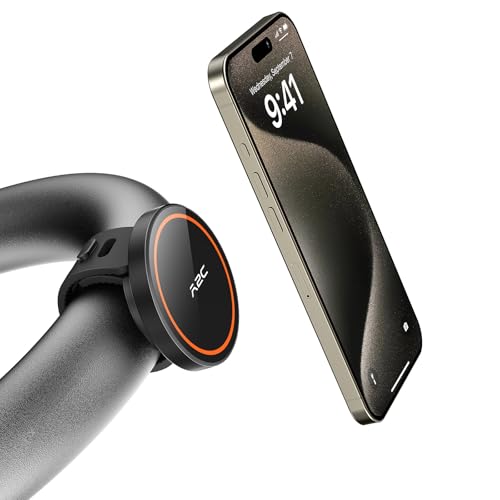
A2C Fitness Phone Mount for MagSafe
Secures your phone with 17 strong N54 magnets providing a high pull force suitable for heavier phones and
Check it on Amazon
welvath Dual Magnetic Phone Holder for Gym or Metal Surface
Offers strong magnetic suction with 28 reinforced N54 magnets, suitable for lighter phones or thin cases with
See this alternative| Product | advertised pull force (N) | Verdict | |
|---|---|---|---|
| A2C Fitness Phone Mount for MagSafe A2C | 0.42328754304 lb × 453.592 g/lb = 192 g × 9.8 m/s² / 1000 = 1.88 N × 2 (dynamic safety factor) = 3.76 N minimum pull force needed; listing implies strong hold with 17 N54 magnets but no explicit pull force published | No rating published | View on Amazon |
| welvath Dual Magnetic Phone Holder for Gym or Metal Surface, for welvath | 0.18077905484 lb × 453.592 g/lb = 82 g × 9.8 m/s² / 1000 = 0.80 N minimum pull force needed; no explicit pull force published but strong magnet count | No rating published | View on Amazon |
| GolbinBox Magnetic Phone Holder for Gym,Adjustable Tripod Mount Ring GolbinBox | No weight published; no pull force rating published | No rating published | View on Amazon |
| APPS2Car Magnetic Phone Holder for Gym APPS2Car | 0.0110231131 lb × 453.592 g/lb = 5 g × 9.8 m/s² / 1000 = 0.05 N minimum pull force needed; claimed hold 22 lbs = 98 N (advertised pull force) | Meets it | View on Amazon |
| HOYXUN Magnetic Phone Holder for Gym HOYXUN | 0.01125 lb × 453.592 g/lb = 5.1 g × 9.8 m/s² / 1000 = 0.05 N minimum pull force needed; no pull force published | Falls short | View on Amazon |
| How to convert grams to newtons | multiply grams by 9.8 then divide by 1000 (g × 9.8 / 1000 = N) |
|---|---|
| Typical safety factor (static) | 1.5–2× phone weight in N |
| Dynamic workouts safety factor | increase to 2–3× or more depending on movement intensity |
| Case gap effect | magnetic force decreases quickly with increasing gap; measure per case |
| Recommended test | use a pull-force gauge or spring scale to verify hold |
| Gym tubing example diameters | 28–35 mm common |
Key takeaways
- Convert phone mass (g) to force (N) by multiplying by 9.8 and dividing by 1000 (g × 9.8 / 1000 = N).
- Use a safety factor of 1.5–2× for static use; increase that factor for dynamic gym movements.
- Case thickness and material reduce magnetic force; the reduction grows rapidly with gap distance.
- MagSafe/ring stickers can add localized magnetic coupling but their benefit depends on sticker strength, placement, and case thickness—measure for your combination.
- For dynamic or high-impact activities, plan for substantially higher pull-force margins (2–3× or more).
- Best practice: measure pull force for your phone + case + sticker using a pull-force gauge or controlled spring-scale test rather than relying solely on advertised numbers.
How to calculate magnetic pull force needed for gym bars
Sizing a magnetic mount starts with the static force your phone exerts due to gravity. Convert device mass (in grams) to force in newtons with this exact relation: N = mass (g) × 9.8 (m/s²) / 1000. For example, a 200 g phone corresponds to 200 × 9.8 / 1000 = 1.96 N of weight force.
A magnetic mount must supply a pull force larger than that gravitational force so the phone does not fall. In practice you do not design to exactly match the weight: small shocks, slight tilts, imperfect contact, and user movement all require a margin. For relatively static mounting (phone hanging on a bar with little motion), a common engineering margin is 1.5–2× the static weight in newtons. That is: Required pull force ≈ (phone mass in g × 9.8 / 1000) × safety factor (1.5–2).
Why 1.5–2×? The safety factor covers several uncertainties: imperfect magnetic contact area, manufacturing tolerances in magnet strength, friction on the mounting surface, and mild dynamic loads. If you have reliable test data for your specific mount and case, you can justify a lower multiplier; if not, stick with the higher end of the range.
The calculation steps: The other half of this decision is using plates and rings with magsafe mounts.
1) Weigh the phone with the case on a precise scale (grams).
2) Convert to newtons: Nweight = grams × 9.8 / 1000.
3) Multiply by the static safety factor (1.5–2) to get a baseline required pull force for low-motion use. There is more on mount for 32 mm squat rack bar in a separate guide.
4) Add allowance for case gap and dynamic forces (see the following sections).
Example: a 220 g phone → 220 × 9.8 / 1000 = 2.156 N. Multiply by 1.5–2 → baseline 3.2–4.3 N before case and motion adjustments.
| Phone Weight (g) | Weight (N) | Baseline (1.5×) (N) | Baseline (2×) (N) |
|---|---|---|---|
| 150 | 1.47 | 2.2 | 2.94 |
| 200 | 1.96 | 2.94 | 3.92 |
| 230 | 2.25 | 3.37 | 4.50 |
how to size magnetic mounts (pull force) and how magsafe/ring stickers and cases affect hold on gym tubing, bars and vents
This heading restates the user's query and introduces the key practical variables: the phone's weight (converted to newtons), case thickness/material, whether a MagSafe or ring sticker is used, the mount geometry, and the expected motion (static vs dynamic).
Cases and ring stickers do two things to the magnetic coupling between phone and mount: they change the distance (gap) between the primary magnets, and they can add localized magnetic material (a sticker) that modifies the flux path. Both effects are highly dependent on exact geometry and materials. The only reliable approach is to reason from physics and then verify by measurement.
Physics principles you can rely on:
- Magnetic force depends strongly on distance: for simple magnet configurations, force decreases rapidly as gap increases; inverse-square or faster relationships are common depending on magnet shape and flux path. This is why even a few millimetres of case can materially reduce pull force.
- Adding a magnetic ring/sticker places magnetized material closer to the mount’s field and can restore or concentrate flux in a small area. The net benefit depends on the sticker’s magnet grade, thickness, alignment, and how the case shifts the sticker relative to the mount.
- Contact geometry matters: a flat phone-to-mount interface maximizes flux linkage, while curved bars and limited contact area reduce effective pull.
- Measure your phone+case weight in grams and convert to newtons (g × 9.8 / 1000).
- Use the static safety factor (1.5–2×) as a baseline.
- Expect additional reductions in effective pull force as case thickness grows; measure or compensate.
- Treat MagSafe/ring stickers as conditional helpers—not guaranteed add-ons—and verify with tests.
A2C Fitness Phone Mount for MagSafe
Secures your phone with 17 strong N54 magnets providing a high pull force suitable for heavier phones and thick cases during dynamic gym activities.
- Weight 0.42328754304 Pounds
How case thickness and materials change pull force (what to expect and how to measure)
Case thickness introduces an air (or polymer) gap between magnet faces. Magnetic attractive force falls quickly with gap; depending on magnet geometry and flux return path, the falloff can approximate an inverse-square trend or be even steeper. That means each additional millimetre of case often reduces pull force by a useful-but-variable percentage, not a fixed number.
Common silicone or TPU thin cases (1–2 mm) will reduce force less than thick rugged cases (2–4 mm). Instead of relying on a single universal correction number, use ranges and measurements: many reviewers and manufacturers report reductions anywhere from ~10% up to 60% for thick, soft cases. The exact effect depends on magnet type (e.g., multiple NdFeB arrays vs single disk), case material magnetic permeability, and how the case deforms under load.
Because published quantifications vary, the most reliable options are:
1) Check manufacturer test data or third-party pull-force tests for your exact mount + case combination, if available.
2) Measure directly with a pull-force gauge (digital force gauge) or a calibrated spring scale in a controlled pull test (slow, normal to the surface).
3) If you cannot measure, assume a conservative reduction and increase the baseline pull force requirement accordingly (for example, plan for a 25–50% reduction for 2–3 mm soft cases as a conservative window).
- Thin cases (≤1.5 mm): smaller reductions, often manageable with medium-strength mounts.
- Moderate cases (1.5–3 mm): expect significant reductions; test to confirm.
- Rugged cases (>3 mm or with metal inserts): can block or reroute magnetic flux severely—do not assume ring stickers fully compensate.
welvath Dual Magnetic Phone Holder for Gym or Metal Surface, for MagSafe
Offers strong magnetic suction with 28 reinforced N54 magnets, suitable for lighter phones or thin cases with documented magnetic strength.
- Weight 0.18077905484 Pounds
How MagSafe ring stickers actually affect hold (qualified and test suggestions)
MagSafe ring stickers are small magnet assemblies designed to localize or augment the magnetic field at the phone’s back. They can help when the phone or case alignment is otherwise poor, but the net change in pull force depends on: sticker magnet grade/size, placement relative to the mount, case thickness and material, and the mount’s magnet array.
Publicly available data from reviewers who test pull force on mounts shows a wide spread in reported benefit. Some tests report modest improvements for thin cases, while others show little to no improvement for thick or poorly aligned cases. Because sticker strength and quality vary by manufacturer, an assumed single-number boost (for example, “adds 2–3 N”) is unreliable without specifying sticker and case.
Practical advice:
1) Treat stickers as conditional: they can restore coupling for thin-to-moderate cases, but they are not a universal fix.
2) If you rely on a sticker, measure using the assembled phone+case+sticker and the mount. A pull-force gauge gives a direct reading; a careful tilt or slow-pull test can be a reasonable proxy.
3) If you need documented performance, seek third-party tests for the specific sticker model or do your own measurement. Do not assume a sticker will move a concrete amount of newtons without verification.
- Sticker benefit is variable—measure for your phone and case.
- Stickers work best within thin-to-moderate cases where the sticker is close to the mount.
- For rugged or >3 mm cases, expect reduced or no benefit from a sticker.

Dynamic forces during gym activities — why static multiplication isn’t enough
Workouts introduce accelerations, impacts, and lateral forces that increase the required holding force well beyond static weight-based values. Consider a phone attached to a bar during pull-ups: swinging, quick direction changes, or sudden stops create additional inertial forces (F = ma) that add to gravity.
A simple way to include dynamics is to multiply the static weight force by an estimated peak acceleration factor. For mild motion use a multiplier of ~2× the static force; for high-dynamic activities (jumping jacks, running, aggressive swinging, or off-road biking) use 2–3× or more depending on intensity and observed jolts. That means the overall required pull force can easily be several times the static baseline.
Examples to illustrate:
- Static hold (little motion): baseline = weight × 1.5–2
- Moderate dynamic (bodyweight exercises with occasional swings): baseline × ~2
- High-dynamic (off-road biking, active impact): baseline × 2–3+
Because dynamics are situation-specific, perform real-world dynamic tests: mount the phone, then subject it to representative motions while observing for slip. Better: use a pull-force gauge during controlled acceleration tests (for example a pendulum or slide test) to quantify peak forces.

APPS2Car Magnetic Phone Holder for Gym
Provides a magnetic base with 6 N52 magnets and claims hold up to 22 lbs (98 N) but lacks test methodology for pull force rating.
- Weight 0.0110231131 pounds
- Size Standard Black - 1 Pack
Practical examples and measurement methods (how to verify your setup)
1) Measurement with a pull-force gauge: Attach the phone to the mount and place a looped cord or fixture between phone and gauge. Pull straight out (normal to the face) at a slow constant speed until the phone separates; record peak force. That reading is the true hold for that phone+case+sticker+mount configuration.
2) Spring-scale tilt test: Secure the mount and attach the phone. Slowly tilt the mount or bar until the phone starts to slip; measure the angle θ at slip. The normal force component gives a way to compute the equivalent holding force. This is less direct than a pull gauge but can be done with minimal equipment.
3) Dynamic trial: Perform representative movements (e.g., swinging on parallel bars, light jumping) while watching for initial slip. If small slips occur, increase magnet strength, change case, or add/remount the sticker and retest.
Practical recommended targets (use as guidance, not absolute rules):
- Static/light duty (light phone, thin case, small bar): baseline pull force ≈ weight × 1.5–2.
- General gym filming (moderate motion, typical phones in thin cases): aim for overall pull capacity 2× static baseline or higher.
- High-dynamic or uneven surfaces (bike trails, heavy swinging): plan for 2–3× baseline or choose mounts with extra margin and mechanical retention.
| Activity | Multiplier vs static weight | Recommendation |
|---|---|---|
| Stationary filming / vents | 1.5–2× | Baseline margin; test once |
| General gym movement (weights, controlled swings) | ≈2× | Aim for a mount with margin over baseline |
| High-dynamic (off-road, heavy impacts) | 2–3× or more | Use strongest mounts, mechanical clamps, or redundant retention |
Selecting a mount and final checklist
When choosing a mount for gym tubing, bars, or vents:
1) Start with the conversion: get your phone+case mass in grams and convert to newtons (g × 9.8 / 1000).
2) Apply a static safety factor of 1.5–2×. If you expect dynamic loads, increase the factor (2–3× or more).
3) Account for case thickness: assume a conservative performance reduction and plan to test. If you cannot test, choose a stronger mount to compensate.
4) Treat MagSafe/ring stickers as assisting elements, not guaranteed multipliers—verify their effect for your exact case and mount.
5) Prefer mounts that publish pull-force ratings and, ideally, independent third-party test results. If a mount lists pull force in newtons, compare that figure to your computed required pull force including all adjustments.
Final checklist before trusting a mount in active use:
- Weighed phone+case and converted to newtons.
- Chosen a safety factor appropriate to expected motion.
- Tested assembled phone+case+sticker on the mount with a pull-force gauge or dynamic trial.
- Verified margin of safety (no tiny slips during representative motion).
Compute required pull force from phone mass (g) converted to newtons (g × 9.8 / 1000), apply an appropriate safety factor for static or dynamic use, and then verify the assembled phone+case+sticker on the mount with a pull-force gauge or dynamic test. MagSafe/ring stickers can help but their benefit is variable—measure, don't assume fixed N gains.
Questions people still ask
How do I measure my phone's weight for magnetic mount sizing?
Use a precise kitchen or postal scale to weigh the phone with its case (in grams). Convert to newtons with: N = grams × 9.8 / 1000. Then apply the safety factor(s) described above.
Can MagSafe ring stickers work with non-Apple phones?
Yes, they can provide localized magnetic coupling on non-Apple phones, but effectiveness varies. Alignment, sticker strength, and case thickness determine the result. Always test the assembled system—phone+case+sticker—on the mount you plan to use.
Why does case thickness reduce magnetic hold so much?
Magnetic force decreases rapidly with increasing gap between magnets; depending on magnet geometry the falloff can be inverse-square or faster. Each millimetre of case adds gap and reduces flux linkage. Material permeability and magnet arrangement also change the effect.
Are all magnetic mounts rated with pull force in newtons?
Many quality mounts specify pull force in newtons (N) or pounds-force. If a manufacturer omits numbers, look for independent third-party tests or measure the pull force yourself. Don’t rely on vague marketing terms.
What if my gym bar is textured or not round?
Textured or non-round bars reduce contact area and effective pull. Increase your required pull force by an additional safety margin (e.g., 20–30% or more) and prefer mounts designed to clamp or provide mechanical grip for irregular surfaces.